
Key Takeaways
- Upper airway resistance syndrome (UARS) sits between simple snoring and obstructive sleep apnea.
- It causes airflow limitation and increases respiratory effort, not full breathing interruptions.
- Standard sleep tests can miss UARS because oxygen levels usually stay normal.
- Common signs include excessive daytime sleepiness, morning headaches, and sleep fragmentation.
- Treatment options include CPAP, oral appliances, and lifestyle changes.
One condition that is frequently overlooked is upper airway resistance syndrome (UARS). Because it does not always cause loud snoring or noticeable breathing pauses, many people live with symptoms for years before getting the right diagnosis.
What is upper airway resistance syndrome?
If you’ve searched “what does UARS mean?”, the answer is simple.
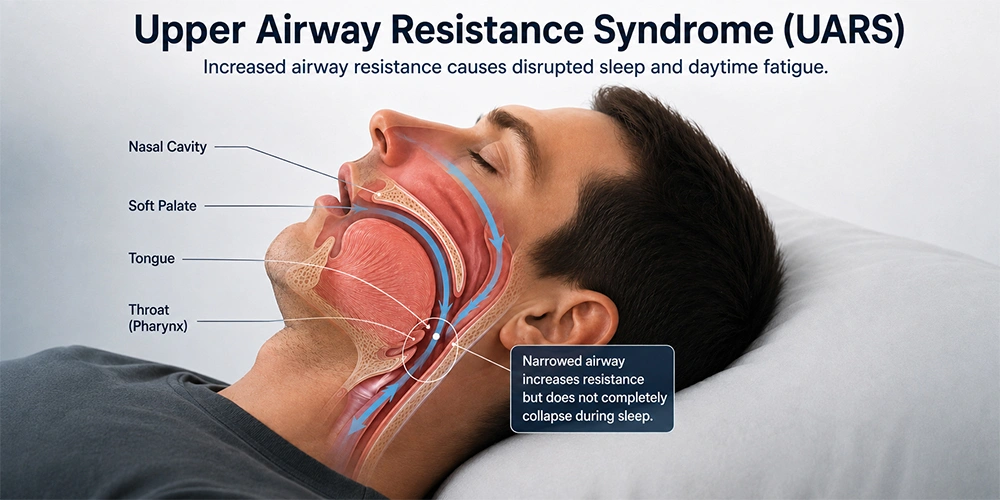
UARS is a condition where your upper airway partially narrows during sleep. This creates airflow limitation, meaning air struggles to move freely even though the airway isn’t fully blocked.
The extra effort it takes to breathe triggers your brain to briefly wake you up, again, all night. These micro-awakenings are called respiratory effort-related arousals, or RERAs. You usually don’t remember them, but they fragment your sleep just the same.
Think of UARS as the middle ground between simple snoring and obstructive sleep apnea (OSA). Your airway stays open enough for air to pass through, but it becomes narrow enough that your body has to work much harder to breathe.
Quick Fact:
Upper airway resistance syndrome (UARS) was first identified and characterized by researchers at Stanford University. They studied patients who experienced excessive daytime sleepiness and disrupted sleep but did not meet the traditional criteria for obstructive sleep apnea. Their research showed that increased breathing effort, even without complete airway blockage or major oxygen drops, could still interrupt normal sleep.
Today, sleep specialists recognize UARS as part of the spectrum of sleep-disordered breathing. However, it is often overlooked because symptoms such as fatigue, poor concentration, and unrefreshing sleep can resemble other sleep problems.
How UARS differs from simple snoring?
It’s easy to assume that all nighttime breathing sounds mean the same thing, but that’s not always true. Understanding the difference can help you recognize when it is harmless and when it may point to an underlying sleep disorder.
Let’s first quickly understand this common issue.
What Is Snoring?
Snoring is the sound created when air passes through relaxed tissues in the throat, causing them to vibrate during sleep. The types of snoring can range from occasional sounds that do not affect your health to more frequent patterns linked with sleep-related breathing problems.
However, you may wonder: Is snoring bad? The answer depends on how often it occurs and whether it affects your sleep quality. Occasional episodes are usually harmless, but frequent nighttime noise combined with daytime fatigue, restless sleep, or morning headaches may be a sign of an underlying condition.
Unlike simple snoring, upper airway resistance syndrome (UARS) involves increased breathing effort and repeated sleep disruptions called respiratory effort-related arousals (RERAs). These interruptions can leave you feeling tired even when you do not experience loud sounds or complete airway blockages.
Upper airway resistance syndrome (UARS) vs. sleep apnea
A common question is the difference between UARS and sleep apnea. Both fall under the umbrella of sleep-disordered breathing, but they’re measured and treated differently.
OSA involves complete or near-complete airway blockages, along with drops in blood oxygen. UARS involves airway obstruction that’s partial. Breathing continues, but with far more effort than it should take.
Because standard sleep study scoring focuses on oxygen drops and full pauses, UARS can be easy to miss on a basic report.
What causes upper airway resistance syndrome?
Understanding what causes upper airway resistance syndrome starts with airway anatomy. Some people naturally have a narrower airway, a smaller jaw, or a lower resting muscle tone in the throat.
But why does UARS occur in otherwise healthy people? It often comes down to a mix of structural and lifestyle factors working together.
Common Risk Factors
A naturally narrow nasal passage or deviated septum.
- A small or recessed lower jaw (retrognathia).
- Chronic nasal congestion or allergies.
- Low muscle tone in the throat during sleep.
- Sleeping on your back, which can worsen airway obstruction.
- Being younger and leaner than the typical sleep apnea patient.
Genetics and facial structure also play a role, which is why UARS can run in families.
Signs of upper airway resistance syndrome (UARS)
The signs of upper airway resistance syndrome (UARS) are not always easy to recognize because the condition often does not cause obvious breathing pauses.
During a sleep evaluation, a sleep specialist may identify signs such as increased breathing effort, airflow limitation, and respiratory effort-related arousals (RERAs) that interrupt normal sleep.
However, many people first notice the effects through how they feel during the day. These symptoms can often look like general fatigue or poor sleep rather than a breathing-related issue.
Common symptoms include:
- Excessive daytime sleepiness, even after a full night’s sleep.
- Frequent morning headaches.
- Trouble concentrating or experiencing “brain fog.”
- Sleep fragmentation, leading to light or restless sleep.
- Anxiety, irritability, or mood changes.
- Insomnia-like symptoms, such as difficulty falling asleep or staying asleep.
Quick Self-Check
Ask yourself these questions:
- Do you wake up feeling tired almost every morning?
- Do you struggle to stay focused during the day?
- Has someone told you that you snore or breathe heavily while sleeping?
- Do you feel like you sleep enough but never feel rested?
If you answered “yes” to several of these questions, it may be worth discussing your symptoms with a sleep specialist.
How is upper airway resistance syndrome diagnosed?
Diagnosing UARS requires a more detailed look than a routine sleep test. The gold-standard tool is polysomnography, an overnight sleep study that tracks brain waves, breathing effort, and airflow patterns.
For a confirmed upper airway resistance syndrome diagnosis, sleep specialists often look at airflow shape on the nasal pressure sensor, not just oxygen levels or full apneas. A flattened breathing wave can point to airflow limitation even when oxygen stays steady.
This is why seeing an experienced sleep specialist matters. General screening tools can miss UARS entirely if they only flag traditional apnea and hypopnea events.
Did you know?
People with upper airway resistance syndrome (UARS) often have a normal Apnea-Hypopnea Index (AHI), which means a basic sleep study may appear normal. In many cases, respiratory effort-related arousals (RERAs) must be specifically evaluated during polysomnography to accurately diagnose the condition.
Sleep Disorder Treatment
Sleep Better. Live Better.
Get personalized treatment for insomnia, sleep apnea, snoring, and other sleep disorders to enjoy healthier, more restorative sleep.
How to treat upper airway resistance syndrome?
If you’re wondering how to treat upper airway resistance syndrome, the answer depends on what is causing the airway to narrow.
The best treatment for UARS is different for every person. Your sleep specialist will consider your symptoms, airway anatomy, and sleep study results before recommending a treatment plan.
CPAP Therapy
CPAP (Continuous Positive Airway Pressure) delivers a gentle stream of air through a mask to help keep the airway open during sleep.
For some people with UARS, CPAP can:
- Reduce breathing effort.
- Improve airflow.
- Minimize RERAs.
- Improve sleep quality.
Although CPAP is commonly associated with sleep apnea, it may also benefit selected patients with UARS.
Oral Appliance Therapy
An oral appliance is a custom-made device worn during sleep.
It gently moves the lower jaw forward, creating more space behind the tongue and helping reduce airway resistance.
Many patients prefer oral appliance therapy because it is compact, quiet, and easy to travel with. A qualified sleep dentist or sleep specialist can determine whether it is an appropriate option.
Additional treatment options
Depending on the underlying cause, treatment may also include:
- Treating allergies or chronic nasal congestion.
- Improving nasal breathing.
- Positional therapy to avoid sleeping on the back.
- Healthy sleep habits.
- Weight management, when appropriate.
- Surgical evaluation for selected anatomical concerns.
To learn more about personalized sleep disorder treatment and other sleep solutions, speak with a qualified sleep professional.
Sleep Disorder Treatment
Sleep Better. Live Better.
Get personalized treatment for insomnia, sleep apnea, snoring, and other sleep disorders to enjoy healthier, more restorative sleep.
Conclusion
Upper airway resistance syndrome (UARS) may be less well known than sleep apnea, but it can still have a significant impact on your sleep quality and overall well-being.
Because the condition causes repeated sleep disruptions rather than obvious breathing pauses, many people spend years searching for answers while living with persistent fatigue and poor sleep.
Understanding the condition, recognizing the symptoms, and seeking an accurate diagnosis are the first steps toward improving your sleep.
If you regularly wake up feeling unrefreshed despite getting enough sleep, don’t ignore your symptoms. A comprehensive evaluation by an experienced sleep specialist can help identify the cause and determine the most appropriate treatment plan.
Frequently Asked Questions
Is Upper Airway Resistance Syndrome serious?
Yes. Left untreated, UARS can cause chronic sleep fragmentation, ongoing fatigue, and a lower overall quality of life. It’s not usually life-threatening on its own, but it deserves proper evaluation and care.
Can UARS turn into sleep apnea?
It can. Over time, especially with weight gain or aging, the airway narrowing behind UARS may progress into full obstructive sleep apnea if left unaddressed.
Is UARS a sleep disorder?
Yes. UARS is classified as a form of sleep-disordered breathing, distinct from but related to snoring and obstructive sleep apnea.
Does UARS cause daytime fatigue?
Yes, this is one of the most common symptoms. Frequent nighttime arousals prevent deep, restorative sleep, leading to excessive daytime sleepiness.
Does UARS cause headaches?
Many patients report morning headaches, likely linked to fragmented sleep and increased respiratory effort throughout the night.
